
How to Get Your Clinic Recommended by ChatGPT and Perplexity
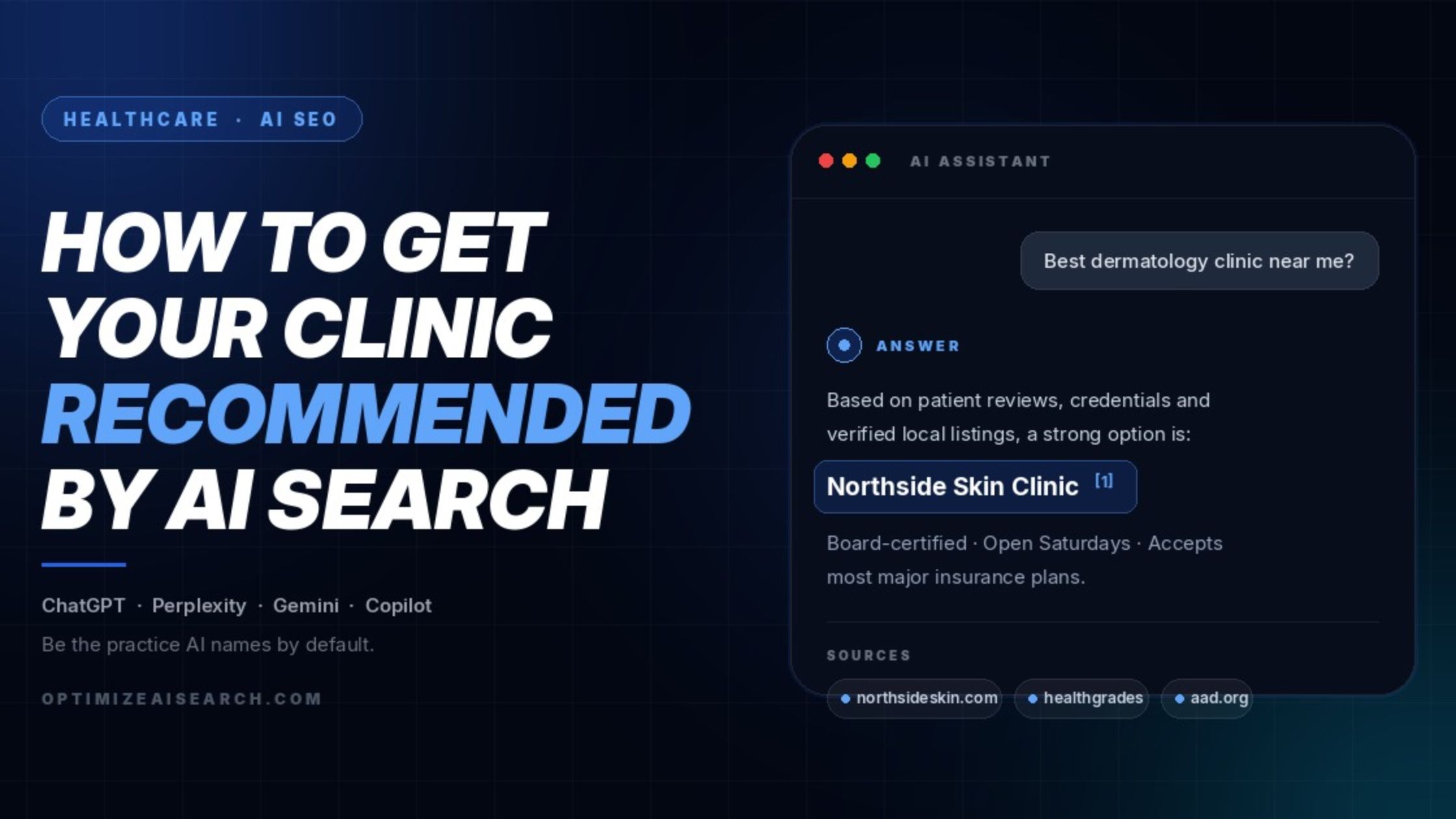
A patient with a swollen knee no longer opens ten browser tabs. They type one sentence into an assistant and ask it to pick. The clinic named in that answer wins the appointment - and the other nine never knew they were in the running.
Something has quietly changed about how patients find care. The old route was a search box, a page of blue links, three or four tabs, and a decision. The new route is a question asked in plain English and a single paragraph of an answer that names one or two providers by name. There is no page two. There is no scrolling. There is a recommendation, and either your clinic is in it or it is not.
Most practice owners we speak to assume this is a ranking problem, and that the fix is more keywords. It is not. Ranking and recommendation are different games with different rules. A model does not scan a page of results and pick the first one - it assembles an answer from sources it can identify, verify, and quote. Your job is to be one of those sources. Below is how that actually works, and what to change on your site this quarter.
Being Ranked and Being Recommended Are Not the Same Thing
Ranking is competitive positioning. Recommendation is an act of trust. When ChatGPT names a dermatology clinic in Chicago, it is not sorting a list - it is making an editorial call about which entity it is confident enough to put its name behind. That confidence comes from convergence: multiple independent sources describing the same practice, the same way, with the same details.
This is why the highest-ranking clinic on Google sometimes gets skipped entirely while a smaller practice down the road gets named twice. The smaller practice is easier to understand. Its site says clearly what it treats and where. Its clinicians are named with credentials attached. Its listings agree with each other. There is nothing for a model to be uncertain about, so it is not uncertain.
Perplexity works differently again. It retrieves live pages, reads them, and cites them inline. That makes it the fastest place to see progress - and the least forgiving of vague copy, because it needs a sentence it can lift and attribute.
Start With the Questions Patients Are Actually Asking
Keyword lists were built for a world where people typed fragments. Nobody types fragments into an assistant. They type the thing they are worried about, in the words they would use with a friend. If your content does not match that phrasing, it will not be retrieved for it.
Here is the shape of the queries that actually convert into appointments:
- "best dermatologist near me for adult acne"
- "which clinic should I go to for lower back pain that won't go away"
- "is my chest pain serious enough for the ER"
- "top rated dental implant clinic in Chicago with financing"
- "can I see an orthopedic doctor without a referral"
- "how much does a knee MRI cost without insurance"
- "recommend a pediatric clinic open on Sunday near me"
- "telehealth therapist accepting new patients this week"
- "what kind of doctor treats vertigo"
- "clinic that speaks Punjabi near Ludhiana"
Notice what these have in common. Every one of them contains a qualifier that a generic service page cannot satisfy - a symptom, a constraint, a cost, a language, a day of the week. That qualifier is the opportunity. Most clinic websites answer "what we do." Almost none answer "can you help me, specifically, with this, today." The practices getting recommended are the ones that took each of those qualifiers seriously enough to write a real answer to it.
What AI Assistants Check Before Naming a Clinic
Across the healthcare accounts we have audited, the same five signals separate the clinics that get named from the ones that get skipped.
- Entity clarity. One canonical practice name, one primary location page per site, no near-duplicate listings competing with each other. Ambiguity is the fastest way to be left out of an answer.
- Structured medical data. MedicalOrganization, MedicalClinic, and Physician markup, with specialties, service areas, accepted insurance, and hours declared in machine-readable form rather than trapped inside an image or a PDF.
- Independent corroboration. Directory profiles, review platforms, medical association memberships, hospital affiliations, local press, and practitioner bios on third-party sites. A claim you make about yourself is weak. The same claim confirmed elsewhere is evidence.
- Named, credentialed humans. Real clinicians with real qualifications, licence details where appropriate, and authorship attached to the clinical content on your site. Medical content published by "Admin" is a trust ceiling you cannot buy your way past.
- Answer-shaped writing. Content that states the conclusion first and explains second. Models extract statements, not narratives.
None of these are tricks. They are the same qualities a referring physician would look for. That is not a coincidence - the models were trained on how humans evaluate medical credibility, so they reward the same things.
Write Pages a Model Can Quote
There is a practical test for this. Open any page on your website and read the first two sentences. If they do not contain a fact that could be lifted, attributed, and still make sense on its own, that page is not going to be cited by anything.
Compare these two openings for the same treatment page. The first: "At our state-of-the-art facility, we are committed to providing compassionate, patient-centred care using the latest technology." The second: "A dental implant procedure at our Chicago clinic takes two visits over three to four months, costs between $3,200 and $4,500 per tooth, and is performed by Dr. Anita Rao, DDS, who has placed over 900 implants." The first sentence says nothing a model can use. The second is a citation waiting to happen.
Structure the page around this principle throughout:
- Lead each section with a direct, quotable statement of fact.
- Use question-form headings that mirror how patients ask - "How long does recovery take?" not "Recovery Information."
- Put specifics in text: prices or ranges, timelines, insurers accepted, languages spoken, wait times, hours.
- Attribute clinical content to a named clinician with credentials and a linked bio.
- Add an FAQ block with genuine patient questions, marked up as FAQPage schema.
- Date the page and update it, so freshness signals stay current.
The Mistakes That Keep Good Clinics Invisible
Some patterns show up in almost every healthcare audit we run, and each one is a self-inflicted wound.
- Location and hours rendered inside an image or an embedded widget, invisible to any crawler.
- Fifteen thin pages, one per keyword variation, instead of three pages that genuinely answer something.
- Ghostwritten clinical content with no author, no reviewer, and no date.
- Directory listings with an old address or a disconnected phone number, quietly contradicting the website.
- Patient stories published without documented written consent - a compliance problem long before it is an SEO one.
- A blog that stopped in 2023, signalling an abandoned practice to anything assessing freshness.
The last two matter more than they look. Trust signals in healthcare are asymmetric: one contradiction can cancel out a dozen positive signals, because a model penalises uncertainty far more harshly than it rewards enthusiasm.
How to Test Whether You Are Being Recommended
You do not need a platform to start measuring this. Take twenty of the questions your front desk hears every week, phrase them the way a patient would, and run them through ChatGPT, Perplexity, Gemini, and Copilot. Record which clinics get named, in what order, and which source pages are cited.
Two findings usually come out of the first hour. First, the same two or three local competitors appear repeatedly - and reading their cited pages tells you precisely what earned the mention. Second, a handful of queries return no local recommendation at all, only generic advice. Those are the open doors. Nobody in your market has written the definitive answer yet, and the first clinic to do it properly tends to hold that position for a long time.
Repeat the exercise monthly. Recommendation share moves gradually and then noticeably, and a simple log will show you the shift well before it shows up in appointment volume.
Where Patient Discovery Goes Next
The direction of travel is towards fewer options presented and more weight on each one. Assistants are moving from listing sources to acting on them - checking availability, comparing costs, and eventually booking. When that becomes routine, being absent from the answer will not mean lower traffic. It will mean not existing in the decision at all.
Two consequences follow for anyone running a practice. Machine-readable operational data - real availability, real pricing, real insurer lists - stops being a nice-to-have and becomes the entry ticket. And authority consolidates: once an assistant is confident about a clinic in a given specialty and city, that confidence compounds, because each new citation reinforces the last. Late entrants do not compete on equal footing.
That is the honest argument for moving now rather than next year. The advantage here is cumulative, and it accrues to whoever starts earliest.
A Realistic First 90 Days
- Weeks 1-2: Run the query audit. Fix every inconsistency in name, address, phone, and hours across your listings. Get hours and location out of images and into text.
- Weeks 3-5: Deploy MedicalOrganization, Physician, and FAQPage schema. Add named clinician bios with credentials and attach authorship to clinical pages.
- Weeks 6-9: Rewrite your top five service pages answer-first, with real specifics. Publish two genuinely useful pieces targeting the unanswered queries you found.
- Weeks 10-12: Build corroboration - association listings, verified directories, local press, practitioner profiles. Re-run the query audit and compare.
This is unglamorous work, and that is exactly why it still works. The clinics winning AI recommendations are not the ones with the largest budgets. They are the ones that made themselves the easiest practice in their city to understand, verify, and quote.
Frequently Asked Questions
How do I get my clinic recommended by ChatGPT?
Make your practice unambiguous and independently verifiable. That means one canonical entity, medical schema on your pages, consistent details everywhere you are listed, named clinicians with credentials, and content that answers patient questions in quotable sentences.
Why does Perplexity cite my competitors instead of me?
Because their pages answer the question in the first two lines and outside sources back up what they claim. Perplexity cites what it can lift and attribute. Marketing copy gives it nothing to work with.
Does schema markup really help?
It does not force a recommendation, but it removes doubt about what your clinic is, where it operates, and who treats patients there. Removing doubt is most of the battle.
How long before I see results?
Live retrieval systems like Perplexity and Google AI Overviews can pick up improved pages within weeks. Broader recommendation behaviour across assistants typically follows over roughly 60 to 90 days as citations and structured data are re-crawled.
Is any of this a HIPAA risk?
Not when it is done properly. Everything above concerns public-facing information - services, credentials, locations, hours, education. No patient data is needed, and no patient story should be published without documented written consent.
The Short Version
Patients are outsourcing the shortlist. The assistant does the comparing now, and it names the clinic it understands best - not the one that spent the most. Everything that earns that name is within your control: clear entity signals, honest specifics in your copy, credentialed authors, structured data, and outside sources that agree with you.
Start with the twenty questions your front desk answers every day. Run them through the assistants. Whatever comes back is your real market position - and the gap between that and where you should be is your roadmap. If you want that mapped out for you, our AI SEO for healthcare team does exactly this, specialty by specialty.
Find Out Whether AI Is Recommending Your Clinic
We will run your practice through ChatGPT, Perplexity, Gemini, and Copilot, show you exactly where competitors are being named instead of you, and hand you the fixes in priority order. Free, and back with you in 24 hours.
Get My Free Healthcare Audit