
How to Get Your SaaS Into AI-Generated Software Shortlists
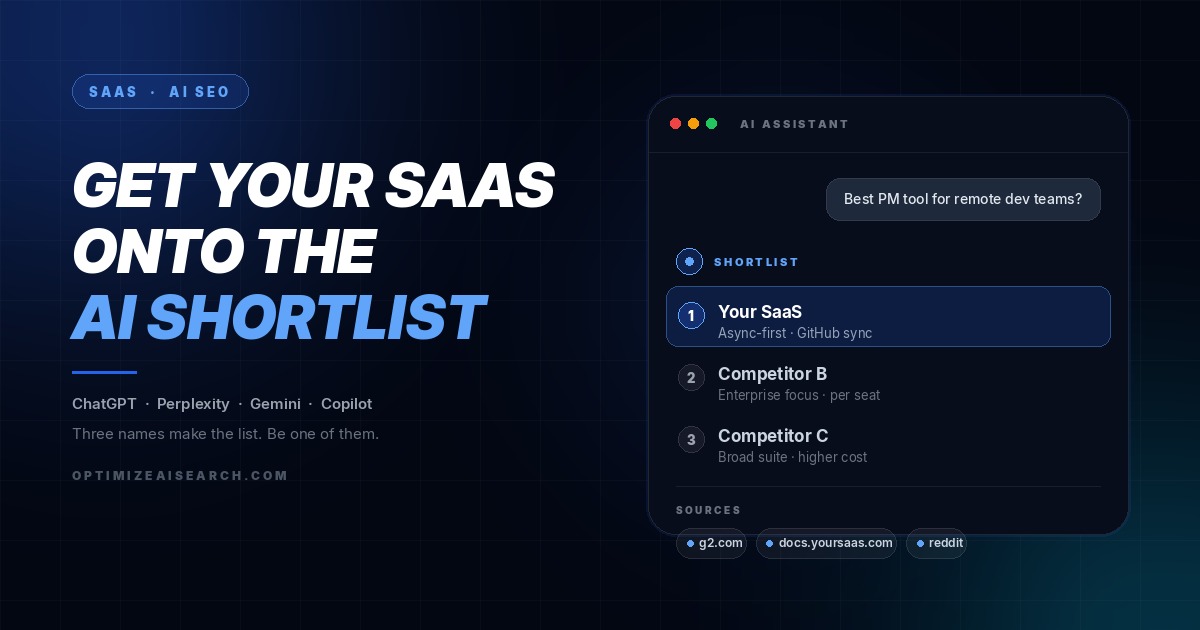
The vendor shortlist used to be built in a spreadsheet by someone who visited fifteen websites. Now it arrives in four seconds, contains three names, and the twelve products left out never register the loss.
Ask any B2B software buyer how their last evaluation started and you will hear a version of the same story. They described the problem to an AI assistant, asked which tools handle it, and got back three or four names with a sentence of reasoning each. Then they visited those websites. The research phase that used to sit at the top of your funnel now happens somewhere you have no analytics for, and it ends with a decision about who gets considered at all.
This is a structural change, not a channel shift. Traffic is not the metric under threat - eligibility is. A product that never makes the shortlist does not get less traffic; it gets removed from the market a buyer believes exists. What follows is how those shortlists are actually assembled, and what to do about it in the next quarter rather than the next fiscal year.
How an AI Assistant Builds a Shortlist
A model is not ranking a list of pages. It is answering a constrained question: which products fit this use case, this team size, this budget, this stack. To do that it needs to have formed a confident internal picture of what each product is and who it is for - and then, in retrieval-based systems like Perplexity or Google AI Overviews, verify that picture against live sources it can cite.
Three things happen in sequence, and each one eliminates candidates:
- Category matching. The model decides which products belong in the set at all. If your positioning is abstract - "the operating system for modern work" - you may not be recognised as belonging to any category a buyer would name.
- Constraint filtering. It narrows by the qualifiers in the query: pricing tier, compliance certification, integration, company size, deployment model. Anything not stated publicly in plain text cannot be matched.
- Confidence ranking. It orders the survivors by how consistently independent sources support the same description. This is where most shortlists are actually won and lost.
The uncomfortable implication is that a well-funded product with vague public information loses to a smaller competitor whose pricing page, docs, and review profiles all say the same specific thing. Clarity beats budget here, which is the closest thing to good news in this shift.
The Queries That Decide Your Pipeline
Traditional keyword research optimised for fragments like "project management software." Nobody phrases a shortlist request that way. Buyers describe their situation, and the situation contains the qualifiers that determine which vendors survive filtering.
These are the query shapes that actually generate shortlists:
- "best project management tool for remote engineering teams under 50 people"
- "what's the best alternative to [competitor] that's cheaper"
- "HR software that integrates with QuickBooks and is SOC 2 compliant"
- "[Competitor A] vs [Competitor B] - which is better for a startup"
- "cheapest CRM with API access and no per-seat pricing"
- "help desk software that doesn't charge per agent"
- "we're outgrowing spreadsheets for inventory - what should we move to"
- "tools that do X and Y in one platform instead of two subscriptions"
- "is [your product] good for enterprise or only small teams"
- "which analytics tool is easiest to implement without engineering help"
Read those again and notice how many hinge on a single fact: a price, a compliance badge, an integration, a seat model, an implementation requirement. Each of those facts is a filter. If it lives behind a "Contact Sales" button, the model treats it as unknown - and unknown loses to stated. That is the entire argument for publishing pricing, and it is now a visibility argument rather than a philosophical one.
Notice also the last two. Buyers ask assistants directly about named products, including yours, and about competitors by name. Whatever the model says in those moments is your positioning, whether you wrote it or not.
Say Exactly What You Are, and Who You Are Not For
Category ambiguity is the most common reason a good product is missing from shortlists. Positioning copy written to sound expansive reads to a machine as unclassifiable, and unclassifiable products get skipped rather than guessed at.
The fix is unfashionable specificity. Somewhere prominent and crawlable, your site should state in plain sentences: what category the product belongs to, the primary use case, the team size and profile it suits, what it integrates with, what it costs, and what it deliberately does not do. That last item is the one nobody writes and the one that helps most - a stated limitation is a strong trust signal, and it prevents you being recommended into evaluations you would lose anyway.
Compare two descriptions of the same product. "A powerful, flexible platform that helps modern teams move faster" tells a model nothing filterable. "Async-first project management for distributed engineering teams of 10 to 200, with native GitHub sync, flat per-workspace pricing from $99/month, SOC 2 Type II certified. Not built for agency client billing." Every clause in the second is a query it can now win.
The Signals That Get You Included
Across the SaaS audits we run, shortlist inclusion tracks a consistent set of signals - and only two of them are on your own website.
- Structured product data. SoftwareApplication, Product, Organization, and FAQPage schema declaring category, pricing, operating system, and features in machine-readable form.
- Crawlable pricing and docs. Public pricing in HTML text, not an image or a gated calculator. Documentation and changelogs that are indexable rather than locked behind a login - these are frequently the most-cited pages a SaaS company owns.
- Review platform depth. Recent, specific, volume-appropriate reviews on the platforms in your category. Assistants lean on aggregated third-party verdicts because they are exactly what a vendor cannot fabricate alone.
- Comparison coverage. Independent "X vs Y" and "alternatives to X" content that mentions you fairly. If every comparison article in your category omits you, you are absent from the model's mental map of that category.
- Practitioner discussion. Real conversations in communities, subreddits, Slack groups, and newsletters where operators explain why they chose a tool. This is unglamorous, slow, and disproportionately influential.
- Crawler access. A robots.txt that permits retrieval agents. Worth checking today rather than assuming.
That last point deserves a sentence of its own. A meaningful number of SaaS companies blocked AI user agents defensively two or three years ago, filed it under risk management, and never revisited it. If that decision is still live in your robots.txt, no amount of content strategy will put you in a citation.
Own the Comparison, Including the Unflattering Ones
Comparison and alternatives queries carry more purchase intent than anything else in B2B software, and they are the queries where assistants most obviously assemble shortlists. Most vendors handle them badly in one of two ways: ignoring them entirely, or writing comparison pages so transparently biased that no model would treat them as a reliable source.
An honest comparison page is a better AI asset than a promotional one, because it can be quoted without embarrassment. That means naming the scenarios where the competitor is the correct choice, using current pricing rather than a screenshot from 2024, and comparing on the dimensions buyers actually raised rather than the ones you happen to win. Publish the page you would be comfortable having a prospect read in front of you.
Then extend it outward. Your own comparison page is one source. Getting mentioned accurately in independent roundups, category reports, and practitioner posts is what turns a claim into consensus.
Measuring Shortlist Share
You cannot manage this from a traffic dashboard, because much of it produces no click. What you can measure is share of voice across a fixed prompt set.
Build a list of 30 to 50 buyer prompts drawn from your sales calls - the actual sentences prospects use to describe their problem. Run them monthly across ChatGPT, Perplexity, Gemini, and Copilot. For each, log whether you were named, in which position, which competitors appeared, and which sources were cited. Within two cycles you will have something more useful than most SaaS marketing dashboards: a direct read on your eligibility in your own category, plus a list of the exact third-party pages influencing it.
Pair that with self-reported attribution at the top of your demo form. When buyers say an assistant suggested you, you have connected shortlist presence to pipeline - which is the version of this story your board will actually engage with. Our AI SEO for SaaS engagements are built around exactly this measurement loop.
Where This Is Heading
Shortlists are getting shorter and assistants are getting more agentic. The trajectory points towards systems that do not just name three vendors but compare their live pricing, check integration compatibility with a company's existing stack, and begin the trial signup. When that is routine, the vendors with machine-readable pricing, public API documentation, and self-serve onboarding will be structurally advantaged over those requiring a sales conversation to reveal basic facts.
There is also a compounding dynamic worth taking seriously. Once a model is confident about which products define a category, each new citation reinforces that association, and challengers face a steeper climb. Category leadership in AI answers behaves less like a ranking you can leapfrog and more like a reputation you have to accumulate.
A Practical First 90 Days
- Weeks 1-2: Audit your prompt set across all four assistants. Check robots.txt for blocked AI agents. Confirm pricing and docs are crawlable HTML.
- Weeks 3-5: Rewrite positioning into filterable specifics - category, use case, team size, integrations, price, stated limitations. Deploy SoftwareApplication and Organization schema.
- Weeks 6-9: Publish or rebuild your comparison and alternatives pages honestly. Fill the use-case gaps where assistants currently return no vendor at all.
- Weeks 10-12: Push on third-party corroboration - review volume and recency, independent roundups, community presence. Re-run the prompt audit and compare share of voice.
Frequently Asked Questions
What is an AI-generated software shortlist?
The two to five vendors an assistant names when a buyer asks which tools fit their use case. It has replaced the manual research phase, and it determines who ever receives a demo request.
How do I get my product recommended by ChatGPT?
State clearly what category you are in and who you are for, publish the specifics buyers filter on, add product schema, and build independent corroboration on review sites, comparison content, and practitioner communities.
Why does G2 outrank my own site in AI answers?
Because third-party aggregated evidence beats a self-description. Your review profiles often shape shortlists more than your homepage does.
Should we block AI crawlers?
Not if you want to be in shortlists. Blocking retrieval agents removes your pages from the pool these systems can cite. Check whether an old defensive decision is still sitting in your robots.txt.
How do we measure any of this?
Share of voice on a fixed prompt set, logged monthly across the major assistants, paired with self-reported attribution on your demo form.
The Short Version
Buyers have delegated the shortlist. The assistant compares now, and it includes the products it can classify, filter, and verify - which is rarely the products with the boldest homepage claims. Everything that earns inclusion is within your control: specific public facts, crawlable documentation, product schema, honest comparisons, and outside sources that describe you the way you describe yourself.
Start with the sentences your prospects use on sales calls. Run them through the assistants this week. Whatever comes back is your real position in your category - and the gap between that and where you should be is the entire roadmap.
See Whether AI Is Shortlisting Your SaaS
We run your category's buyer prompts across ChatGPT, Perplexity, Gemini, and Copilot, show you exactly where competitors are being named instead of you, and hand back the fixes in priority order. Free, within 24 hours.
Get My Free SaaS SEO Audit