The Content Creator's Guide to Getting Cited by ChatGPT, Perplexity, and Google AI
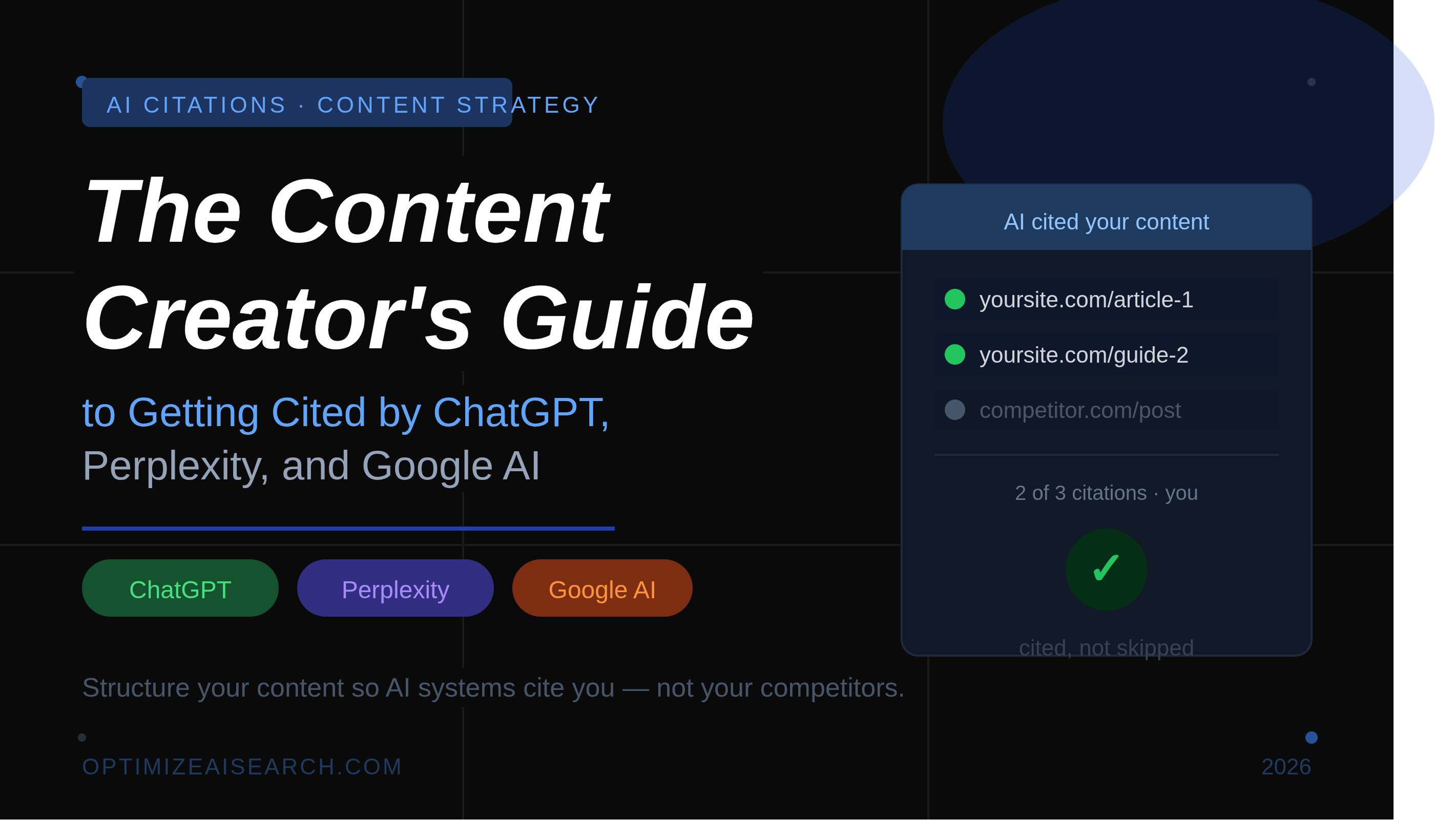
You put in hours to write a well-researched article. It ranks on Google and gets shared. But when someone asks ChatGPT the same question, it gives a generic answer and leaves you out. This gap is costing you the audience that matters most.
Table of Contents
- What Does It Mean to Be Cited by an AI Search Engine?
- AI Citations vs. Traditional Backlinks: What's the Difference?
- How ChatGPT, Perplexity, and Google SGE Select Their Sources
- Why Most Content Never Gets Picked Up by AI
- The Importance of Being a Primary Source
- Writing in Direct-Answer Format
- Schema Markup and Structured Data
- The Role of Backlinks and Domain Authority
- How to Track Whether AI Engines Are Citing Your Content
- Frequently Asked Questions
What Does It Mean to Be Cited by an AI Search Engine?
According to Morgan Hayes, traditional search results that show a simple list of blue links are now rare — almost all Google searches display additional features before the standard organic results. AI search is different. The engine reads dozens of sources, synthesises an answer, and then cites the two or three sources that contributed most to that answer. Being cited means your content made it into that final answer, not just the index.
Think of it like the difference between being in a library and being the book the librarian recommends. Both exist. Only one gets read.
According to a report from The Atlantic, AI search engines such as ChatGPT, Perplexity, and Google AI Overviews are changing how people find information by generating content summaries rather than just providing links. These tools often struggle to consistently cite sources — which means if your content is not structured for these systems to understand, it gets passed over entirely.
💡 Did You Know?
Perplexity AI surpassed 15 million daily active users in early 2026 — and every one of those users receives a cited answer rather than a list of links. Getting into those citations is the new first page of search.
AI Citations vs. Traditional Backlinks: What's the Difference?
A backlink is a vote of confidence from one website to another. It tells Google your content is trusted enough to reference. An AI citation works differently — it means the AI engine found your content specific, clear, and credible enough to pull a direct answer from.
Backlinks help you rank. AI citations get you quoted. Both matter in 2026, but they require fundamentally different strategies. A page can have zero backlinks and still get cited by Perplexity if it answers a question better than anything else on the web. This is the core insight behind Generative Engine Optimization (GEO) — the discipline of optimising content to be cited, not just ranked.
How AI Search Engines Decide Which Sources to Cite
All AI search tools value the same four qualities: clarity, authority, structure, and specificity. A vague, lengthy post is rarely cited, but a focused section that directly answers a question often is — even if the broader page has modest SEO metrics. Understanding this distinction is what separates content that generates ChatGPT SEO results from content that simply sits in an index.
How ChatGPT, Perplexity, and Google SGE Select Their Sources
ChatGPT with Browsing and Perplexity both use live web retrieval. They scan results in real time and look for pages that contain a clean, direct answer near the top of the content. Google's AI Overviews pull heavily from pages that already perform well in traditional search, but they prioritise pages with structured formatting, clear headings, short paragraphs, and factual sentences.
One factor all three engines share: they strongly prefer original information over recycled summaries. If your article is mostly a rephrasing of what five other articles already said, it will not make the cut. Our Google AI Overviews optimisation service is built around exactly these selection criteria.
Expert Insight — OptimizeAISearch
"The content creators we see getting consistently cited share one trait: they write for retrieval, not for reading time. That means the answer is in the first sentence, the structure is predictable, and the information is genuinely original. Those three things alone account for the majority of AI citation wins we track across our client base."
Why Most Content Never Gets Picked Up by AI
Most online content fails the AI citation test for one simple reason: it is written to impress humans, not to inform them. Long introductions, hedging language, and conclusions that repeat the introduction are all habits that make content feel rich but leave AI engines with nothing usable to extract.
AI engines are looking for a clear answer to a specific question. If they have to read four paragraphs to find it, they move on. The content that gets cited is the content that leads with the answer and uses the rest of the section to support it.
- Long introductions that delay the answer. Every sentence before the answer is a sentence the AI may not wait through.
- Hedging language. Phrases like "it depends" and "there are many factors" are citation killers. AI engines need a declarative statement.
- Recycled information. If your content summarises what five other articles said, an AI engine will cite one of those original articles instead.
- Poor structure. Walls of text with no headings cannot be parsed efficiently. No parse, no citation.
⚡ Pro Tip
Open one of your best-performing blog posts right now. Count how many sentences appear before the first direct answer. If the number is more than three, you have an immediate optimisation opportunity that could increase your AI citation rate. Our free AI Search Audit identifies exactly these gaps across your entire content library.
The Importance of Being a Primary Source, Not a Secondary One
Secondary sources summarise what others found. Primary sources present original research, data, direct experience, or first-hand analysis. AI engines strongly favour primary sources because they contain information that is not available elsewhere.
If you run a plumbing business, a post based on jobs you have actually completed beats a generic common-problems article written from research alone. If you are a financial adviser, your take on a tax change based on client cases you have handled carries more weight than a rephrased news summary. Original insight is the single biggest factor that separates cited content from ignored content — and it is the foundation of every GEO content strategy we build.
Structuring Your Content So AI Engines Can Understand and Cite It
Structure is not just about readability — it is about machine comprehension. AI engines parse your page the same way a screen reader does: top to bottom, heading by heading. If your structure is messy, your content becomes hard to process, and hard to process means hard to cite. Every heading should function as a question the paragraph below will answer.
Writing in Direct-Answer Format: How to Match AI Query Patterns
The most effective format is simple: ask the question in a heading, then answer it in the first one or two sentences of the paragraph below. Do not build up to the answer — give it immediately.
For example, if your heading is How long does it take to rank on Google? — the very next line should say something like: Most new pages take three to six months to appear in competitive search results. Then you can elaborate. This format mirrors how AI systems extract answers: they look for the heading, then pull the sentence that follows.
Keep paragraphs to three to five sentences maximum. Break complex points into separate sub-sections. Use plain, specific language rather than broad claims. These are the structural habits that make the difference between content that gets cited and content that gets summarised away by an AI that found a better source. For a complete framework, our guide to AI Overviews optimisation walks through the full structural checklist.
Schema Markup and Structured Data: Making Your Content AI-Readable
Schema markup is code you add to your page that tells search engines exactly what type of content they are reading. It is invisible to readers but gives AI engines a clear map of your page — and it is one of the highest-leverage technical changes you can make for ChatGPT SEO visibility.
- FAQ schema formats your content as question-answer pairs — exactly the structure AI engines are built to process and surface.
- HowTo schema works for instructional content, helping AI engines extract step-by-step answers to process-based queries.
- Article schema provides authorship and publication date signals that contribute to credibility scoring.
You do not need to write code to add schema. Tools like Rank Math, Yoast, or Google's Structured Data Markup Helper can add it without touching your site's backend. But the markup only works if the underlying content is already structured correctly. Schema tells the engine what something is — it cannot fix content that lacks a clear answer.
The Role of Backlinks and Domain Authority in AI Citation Rankings
Backlinks still matter — just not in the way they used to. A high domain authority score tells AI systems that your site has been trusted by others over time. It is a baseline credibility signal. Without it, even well-structured content faces an uphill battle. This is why our broader GEO strategy always includes an authority-building component alongside content optimisation.
But chasing backlinks alone will not get you cited. What matters more now is the quality and specificity of the pages linking to you. A single link from a respected industry publication counts for far more than twenty links from low-quality directories.
The Winning Combination
Earn backlinks through original research and data. Then make sure the pages those links point to are structured for direct-answer retrieval. Authority gets you in the door. Structure gets you cited.
How to Track Whether AI Engines Are Citing Your Content
This is one of the most practical questions in AI SEO right now, and the honest answer is that tracking is still imperfect. AI citation attribution is not yet as transparent as traditional search analytics — but there are reliable methods to monitor your visibility.
- Manual testing. Search for the exact questions your content answers in ChatGPT, Perplexity, and Google's AI Overviews. See if your site gets mentioned. Perplexity is the most transparent — it shows its sources clearly.
- Dedicated tools. Semrush's AI Overview tracker, BrightEdge, and Authoritas are beginning to offer AI citation monitoring. Set up Google Alerts for your brand name to catch AI-generated mentions.
- Google Search Console signals. A spike in impressions without a matching spike in clicks often means your content is appearing in an AI Overview but users are getting the answer without clicking through.
If you want a baseline picture of where you currently stand in AI search, the fastest starting point is a professional AI Search Audit that maps your citation gaps against your top competitors. Our team at Optimize AI Search delivers these assessments with a concrete action plan.
The Future of AI Citations and What to Do Next
AI search is not replacing traditional SEO. It is layering on top of it. The fundamentals still apply: write helpful content, earn trust, build authority. But the bar for what counts as helpful has changed.
Being cited by an AI engine means your content answered a question so clearly, so specifically, and so credibly that a machine chose it above everything else. That is not a trick — it is the natural result of writing with real expertise and presenting it in a way that any human or AI reader can immediately use.
Start with one piece of content. Pick a question your audience genuinely asks. Answer it in the first two sentences under a clear heading. Add FAQ schema. Make sure the information is original. Then check Perplexity in a week and see where you stand. The content creators who adapt now will own the citation layer forming on top of the web — and our Generative Engine Optimization services exist to accelerate exactly that outcome.
Frequently Asked Questions
What does it mean to be cited by an AI search engine?
Being cited means your content was selected as one of the two or three sources the AI used to construct its answer. Unlike ranking in traditional search, being cited means your content made it into the final answer — not just the index. Think of it as the difference between being in a library and being the book the librarian recommends.
How is an AI citation different from a traditional backlink?
A backlink helps you rank on Google. An AI citation means the AI engine found your content specific, clear, and credible enough to pull a direct answer from. A page can have zero backlinks and still get cited by Perplexity if it answers a question better than anything else on the web. Both matter — they just require different strategies.
Why does most content never get picked up by AI engines?
Most content fails because it is written to impress humans rather than to inform them. Long introductions, hedging language, and recycled summaries leave AI engines with nothing usable to extract. AI engines need a declarative answer to a specific question — if they have to read four paragraphs to find it, they move on to a source that leads with the answer.
What is the direct-answer format and why does it matter?
The direct-answer format places the answer in the first one or two sentences under the relevant heading — not after an introduction. This mirrors how AI engines extract answers: they find the heading, then pull the sentence that follows. It is the single most impactful structural change a content creator can make for ChatGPT SEO visibility.
What schema markup types help with AI citations?
FAQ schema, HowTo schema, and Article schema are the most useful for AI citation visibility. FAQ schema is especially powerful because it formats content as question-answer pairs — exactly how AI engines process and surface information. Tools like Rank Math, Yoast, and Google's Structured Data Markup Helper can add schema without writing code.
How do I track whether AI engines are citing my content?
The most reliable method is manual: search for the questions your content answers in ChatGPT, Perplexity, and Google AI Overviews and check if your site is mentioned. For systematic tracking, tools like Semrush's AI Overview tracker, BrightEdge, and Authoritas offer AI citation monitoring. In Google Search Console, a spike in impressions without matching clicks often signals an AI Overview appearance.
Do I need backlinks to get cited by AI engines?
Backlinks matter as a baseline credibility signal, but they are not sufficient alone. A single link from a respected industry publication outweighs twenty links from low-quality directories. The winning combination is earning backlinks through original research, then ensuring those pages are structured for direct-answer retrieval. Authority gets you in the door; structure gets you cited.
What makes a primary source more likely to be cited by AI?
Primary sources contain original research, data, direct experience, or first-hand analysis — information not available elsewhere. AI engines strongly favour them because secondary sources merely summarise what others found. Original insight is the single biggest differentiator between cited and ignored content, and it is the foundation of any effective GEO content strategy.
Ready to Get Your Content Cited by ChatGPT & Perplexity?
Get a comprehensive Free AI Search Audit today and discover exactly where your content stands in AI-driven search — and what it will take to get cited over your competitors. Our GEO specialists at Optimize AI Search will deliver a clear roadmap with no commitment required.
Get Your Free Audit →