
How ChatGPT & Perplexity Are Changing the Way People Shop Online
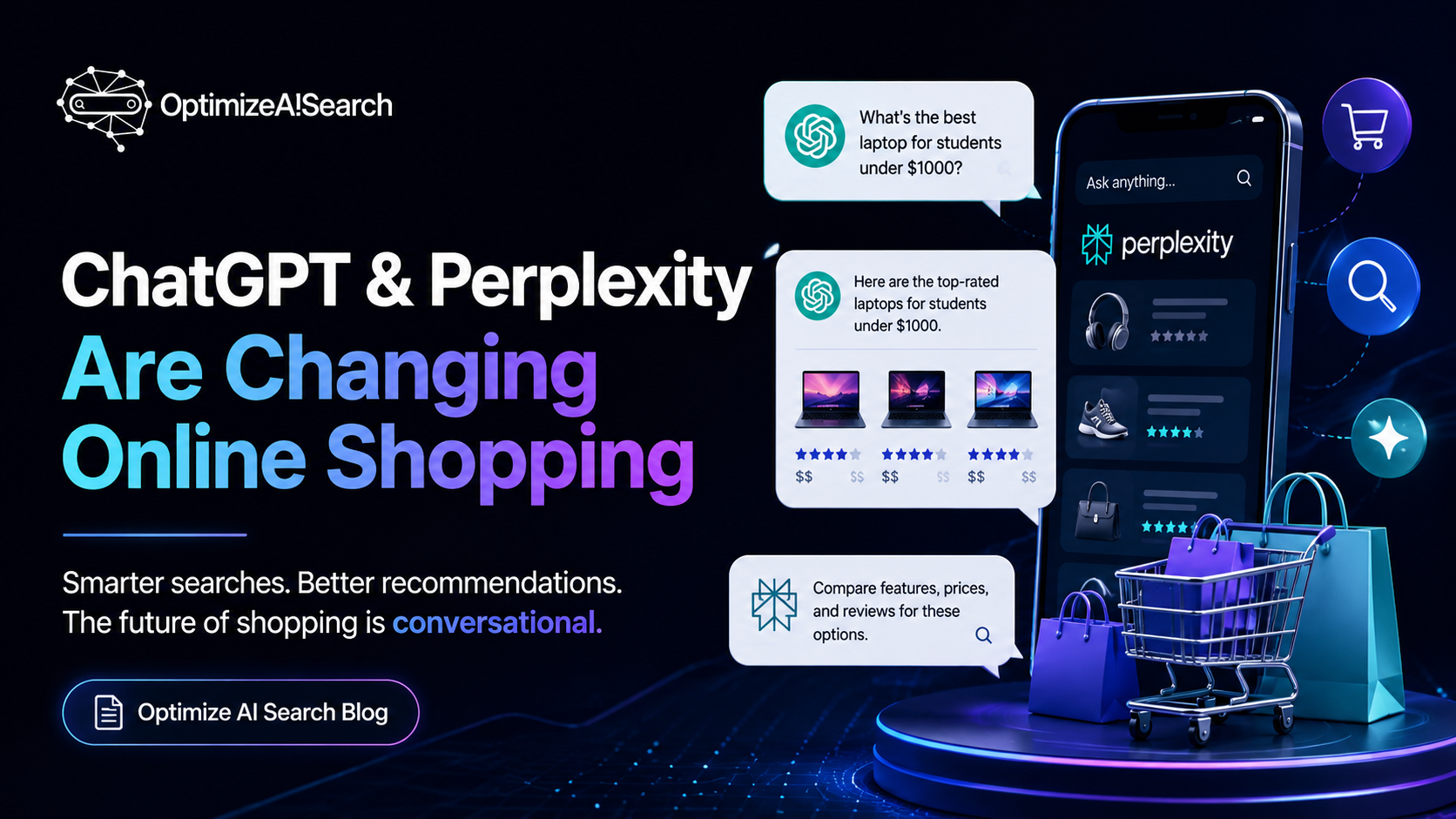
The way people find and buy products online has fundamentally changed. ChatGPT and Perplexity are no longer just research tools — they are active sales channels converting buyers at rates traditional search cannot match.
Table of Contents
- The Old Shopping Journey Is Gone
- What Is AI-Driven Shopping?
- How ChatGPT Is Changing the Way People Buy
- How Perplexity Is Becoming a Product Research Destination
- Why AI-Referred Shoppers Convert Better
- The New Shopping Funnel: Dialogue Replaces Discovery
- What This Means for Ecommerce Store Owners
- Common Mistakes Ecommerce Stores Are Making Right Now
- How to Get Your Products Recommended by ChatGPT and Perplexity
- Frequently Asked Questions
The Old Shopping Journey Is Gone
Think about how you used to shop online. You typed something into Google — "best standing desk under $400" — scrolled through a list of articles, clicked three or four of them, compared specs across tabs, and eventually made a decision thirty minutes later.
That journey is disappearing fast.
Today, a growing number of shoppers skip that entire process. They open ChatGPT or Perplexity, type a question in plain English, and get a specific product recommendation with reasoning — in seconds. No scrolling. No tabs. No comparison fatigue.
This is not a niche trend. Traffic to US retail websites from AI sources grew 693% during the 2025 holiday season, according to Adobe Analytics. And 56% of US consumers used generative AI during that same period, up from just 11% the year before.
The shopping journey has fundamentally changed. The brands that understand this — and optimize for it — are already pulling ahead.
What Is AI-Driven Shopping?
AI-driven shopping refers to consumers using large language model (LLM) platforms — such as ChatGPT, Perplexity, Google Gemini, and Microsoft Copilot — to research, compare, and purchase products. Instead of searching for a list of websites, shoppers have a conversation. They describe what they need. The AI interprets their intent, pulls relevant product information from across the web, and recommends specific options — often with reasons, comparisons, and direct purchase links.
It sounds like a small shift in interface. The implications for ecommerce AI SEO are enormous.
💡 Did You Know?
AI-referred shoppers convert at 12.3% compared to just 3.1% for non-AI-assisted shoppers — and they spend 45% more time exploring products once they land on a page. (Source: Adobe Digital Insights, 2026)
How ChatGPT Is Changing the Way People Buy
ChatGPT has crossed 900 million weekly active users in 2026. A significant and growing portion of those users are now using it to make shopping decisions. OpenAI's push into commerce has been deliberate and aggressive — they embedded checkout directly into ChatGPT in late 2025, allowing users to purchase products without leaving the conversation. Retailer partnerships with Target, Instacart, Etsy, and over a million Shopify merchants enable real transactions directly inside the chat interface.
The result? ChatGPT is now generating serious, measurable referral traffic for major retailers:
- Walmart gets 20% of its referral traffic from ChatGPT
- Etsy receives over 20% from ChatGPT
- Target sees approximately 15%
- eBay approximately 10%
And here is the critical point most store owners miss: when ChatGPT recommends a product, the shopper arrives at your site already decided. They are not in research mode. They have been pre-sold by an AI recommendation. All you have to do is not lose them.
The Agentic Shopping Era
2026 is the year "agentic commerce" moves from concept to reality. Agentic shopping means the AI does not just suggest products — it completes the purchase on your behalf. A user can say "buy me the best noise-cancelling headphones under $250, ship to my address," and the AI handles the entire transaction.
Getting recommended by the AI is no longer just about traffic — it is about revenue that flows entirely outside your own website. According to McKinsey (October 2025), agentic commerce could redirect $3 to $5 trillion in global retail spend by 2030.
How Perplexity Is Becoming a Product Research Destination
Perplexity launched in late 2022 as an "answer engine" — a search tool that gave direct answers with citations instead of a list of links. It has since evolved into one of the most important product research destinations on the internet. Perplexity Shopping allows users to research and compare products through natural conversation, surfacing real-time product data, prices, and merchant information. Its model architecture is optimized for factual retrieval and transparency — it cites sources with every answer, which builds consumer trust in its recommendations.
Ahead of Black Friday 2025, Perplexity announced a partnership with PayPal enabling direct purchases from AI search results — without the shopper ever visiting the merchant website. PayPal serves over 430 million active accounts, and 75% of transactions use saved user credentials, meaning friction to purchase is near zero.
For ecommerce store owners, this creates an urgent question: if a shopper can find and buy your product inside Perplexity without visiting your store, is your product even showing up there?
Expert Insight — OptimizeAISearch
"Based on working with ecommerce stores across both India and the US, I've consistently seen a pattern: brands that invested in AI search visibility in early 2025 are now getting a disproportionate share of AI-referred traffic. The window for early-mover advantage is still open — but it is closing. Stores that wait until AI-driven shopping becomes the obvious majority behavior will find the competitive ground already occupied."
Why AI-Referred Shoppers Convert Better
This is the part that changes the business case entirely. AI-referred shoppers do not behave like typical organic traffic. They arrive at your product page with:
- A specific need already articulated — they have described what they want to the AI
- Social proof from the AI itself — the recommendation carries implicit trust
- A compressed decision timeline — the research phase already happened inside the AI conversation
Adobe Analytics data confirms this: AI-referred shoppers were 33% less likely to bounce from retail sites and converted 31% more than shoppers from other sources. The funnel has been pre-filtered. By the time an AI-referred shopper lands on your product page, they are closer to buying than almost any other traffic source — including paid ads. This changes the ROI conversation around ChatGPT SEO entirely.
The New Shopping Funnel: Dialogue Replaces Discovery
The traditional ecommerce funnel:
The AI-powered funnel:
The entire middle of the funnel — category pages, comparison content, SEO blog articles — is now happening inside the AI before the shopper ever reaches you. This has two major implications:
- Brand awareness is built inside the AI conversation. If your brand is not mentioned when someone asks ChatGPT for a recommendation in your category, you effectively do not exist for that shopper.
- The last click matters more than ever. Because the AI pre-sells the shopper, your product page needs to close — not educate from scratch, not explain your category. Close.
What This Means for Ecommerce Store Owners
If you run an online store — whether on Shopify, WooCommerce, Magento, or a custom platform — here is what the AI shopping shift means practically:
- Your Google rankings are no longer your only distribution channel. A shopper who never visits Google can still find your product and buy it if ChatGPT or Perplexity recommends it. Our ecommerce AI SEO services are designed specifically for this new reality.
- Product data quality is now a competitive advantage. AI platforms surface products with accurate, complete, structured data. Thin descriptions and missing specifications get skipped.
- AI citations compound like backlinks. Every time an AI platform recommends your product, it reinforces your brand credibility. Early visibility creates a compounding advantage that late-movers will find difficult to overcome.
⚡ Pro Tip
The quickest thing you can do today is audit your top 10 product pages for completeness. Go to ChatGPT or Perplexity and search for your product category. If competitors appear and you do not, that gap is costing you revenue right now.
Common Mistakes Ecommerce Stores Are Making Right Now
- Treating AI visibility as optional. AI platforms are already driving double-digit referral traffic percentages for major retailers. Ignoring them is not a neutral position — it is a loss.
- Blocking AI crawlers. Amazon blocked ChatGPT's crawlers to protect its advertising business. The result? Amazon receives less than 3% of ChatGPT-driven referral traffic — declining 18% month-over-month. Smaller stores making the same mistake are not protecting a $4B ad business; they are just leaving revenue on the table.
- Relying on manufacturer descriptions. AI platforms deprioritize generic, duplicated content. If your product descriptions are copied from a supplier catalogue, they are far less likely to be surfaced as citations.
- Ignoring schema markup. Structured data helps AI platforms parse and cite your product information accurately. Stores without schema are harder for AI to recommend confidently. Learn more about Google AI Overviews optimization as a starting point.
- Optimizing only for Google. An SEO strategy built entirely around Google keyword rankings misses the AI search channel completely.
How to Get Your Products Recommended by ChatGPT and Perplexity
Getting your store cited and recommended by AI platforms is the emerging discipline of Generative Engine Optimization (GEO) — the core of what separates stores capturing AI-driven revenue from those being bypassed.
- Write product descriptions for humans AND machines. Clear, specific, factually dense content — with exact specs, use cases, and benefits stated plainly — is what AI platforms extract and cite. Vague, marketing-heavy copy gets skipped.
- Implement structured data. Product schema, Review schema, and BreadcrumbList schema make your product data legible to AI crawlers. This is table-stakes for AI visibility.
- Build topical authority in your category. AI platforms recommend brands they perceive as authoritative. Buying guides, comparison content, and FAQ pages establish your store as a trusted source.
- Keep product data current and accurate. Outdated prices, unavailable SKUs, and broken pages reduce AI citation confidence. Accurate, maintained data gets recommended; stale data does not.
- Allow AI crawlers. Review your robots.txt and ensure you are not inadvertently blocking major AI platform crawlers.
- Earn external mentions. Reviews on third-party sites, brand mentions in publications, and product citations in editorial content all feed AI platforms' understanding of your brand's credibility.
These are not speculative tactics. They are the observable behaviors of stores that show up consistently across ChatGPT, Perplexity, and Google AI Overviews today.
The Competitive Window Is Still Open
AI-driven shopping is not a future trend to monitor. It is a present reality generating measurable revenue for stores that are positioned for it — and quietly draining visibility from those that are not.
The ecommerce brands that built Google SEO authority in 2015 and 2016 captured a decade of compounding organic advantage. The brands building AI SEO for ecommerce visibility in 2025 and 2026 are doing the same thing.
The window is still open. But based on how quickly AI adoption is accelerating — 693% growth in AI-referred retail traffic in a single holiday season — it will not stay open for long. If you want to know where your store stands today, the right starting point is a professional ecommerce AI SEO audit.
Frequently Asked Questions
What is AI-driven shopping and how does it work?
AI-driven shopping is when consumers use AI platforms like ChatGPT or Perplexity to research and purchase products through natural conversation. The AI interprets their need, searches for relevant product data across the web, and recommends specific items — often with direct purchase links. Shoppers receive a recommendation in seconds rather than browsing multiple websites.
Do ChatGPT and Perplexity actually drive ecommerce sales?
Yes, and the numbers are significant. Walmart now receives 20% of its referral traffic from ChatGPT. Adobe Analytics found that AI-referred shoppers convert 31% better than shoppers from other sources and are 33% less likely to bounce. AI platforms are active sales channels, not just research tools.
How is shopping on ChatGPT different from shopping on Google?
Google shows you a list of pages to explore. ChatGPT and Perplexity give you a specific recommendation with reasoning — the decision-making process happens inside the AI conversation. By the time a shopper clicks through to a product page from an AI platform, they are already pre-sold, which is why AI-referred traffic converts at dramatically higher rates than traditional organic search.
What is Perplexity Shopping?
Perplexity Shopping is the ecommerce feature built into Perplexity that lets shoppers research and compare products through chat. It has partnered with PayPal to enable direct purchases inside the Perplexity interface, meaning shoppers can buy products without ever visiting the merchant website.
How do I get my products to appear in ChatGPT recommendations?
Getting your products cited by ChatGPT requires structured product data, schema markup, original and complete product descriptions, topical authority content, and allowing AI crawlers to access your site. This practice is called Generative Engine Optimization (GEO) and is the emerging standard for AI search visibility.
What is agentic commerce?
Agentic commerce is when an AI agent completes a purchase on a consumer's behalf — researching, selecting, and buying the item all within a single conversation. By 2030, McKinsey estimates agentic commerce could redirect $3 to $5 trillion in global retail spend.
Why is Amazon losing ground to AI shopping platforms?
Amazon blocked ChatGPT's crawlers in its robots.txt to protect its advertising business. As a result, Amazon product listings cannot be surfaced in ChatGPT shopping results, and its share of ChatGPT-driven referral traffic is declining 18% month-over-month. Brands selling on their own Shopify stores have a significant first-mover advantage.
How quickly do AI SEO results appear for ecommerce stores?
Initial improvements in AI visibility can appear within 4 to 8 weeks of implementing structured data, content optimization, and technical fixes. Sustained citation authority builds over 3 to 6 months of consistent optimization — similar to the compounding timeline of traditional SEO.
Ready to Get Your Store Found in ChatGPT & Perplexity?
Get a comprehensive Free AI Search Audit today and discover exactly where your store stands in AI-driven search — and what it will take to get recommended over your competitors. Our ecommerce AI SEO specialists at Optimize AI Search will deliver a clear roadmap with no commitment required.
Get Your Free Audit →