Almost every SEO agency now lists "AI search optimization" on its website. Some have rebuilt how they work. Others have renamed their old packages. From the outside, the two look the same.
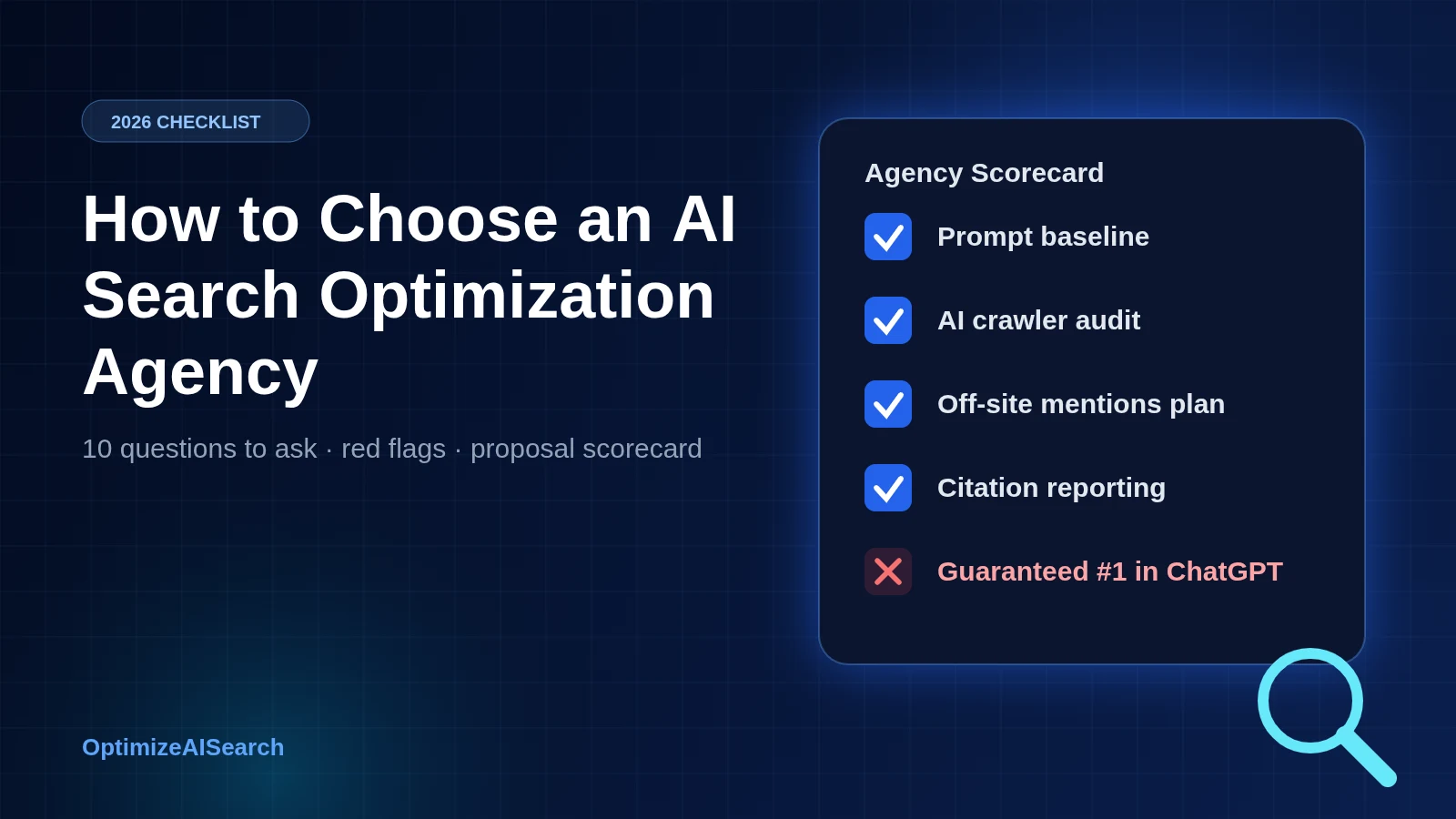
This guide gives you a practical way to tell them apart. It covers what the work should include, ten questions to ask on the sales call, the red flags that should end the conversation, and how to compare two proposals side by side.
What an AI search optimization agency should actually do
AI search optimization means getting your brand cited and recommended inside AI answers: ChatGPT, Perplexity, Gemini, Copilot, Google AI Overviews and Google AI Mode. You'll also hear it called GEO (generative engine optimization) or AEO (answer engine optimization).
Google's own guidance, published in May 2026, is clear that this is still SEO. There is no special file, hidden markup or secret format that gets a page into AI answers. Pages need to be indexed, eligible for snippets, and genuinely useful.
So a good agency's work should look familiar, with a few important additions:
- Technical access. Making sure Googlebot and AI crawlers such as OAI-SearchBot and PerplexityBot can reach and read your pages.
- Answer-first content. Pages that answer the questions buyers ask AI tools, with the answer near the top and real detail below it.
- Entity consistency. Your company name, services, locations and people described the same way on your site, your Google Business Profile, directories and social profiles.
- Third-party mentions. AI tools rely heavily on what other sites say about you: reviews, "best of" lists, industry directories, forums and press.
- Prompt tracking. A fixed set of buyer questions tested every month, so you can see whether your brand is named more often.
If a proposal only covers keywords, blog posts and backlinks, it's a traditional SEO package with a new label. For a side-by-side example, see what our AI search optimization agency program includes.
10 questions to ask before you hire
1. Which prompts will you track, and can I see the baseline?
This is the most useful question you can ask. A serious agency will agree on 30 to 50 prompts with you, such as "best CRM for small law firms" or "who does AI SEO for clinics in Chicago". Then it will record where you appear today. Without a baseline, no one can prove progress later.
2. Which AI platforms do you test, and how often?
Your buyers don't all use the same tool. At a minimum, look for ChatGPT, Google AI Overviews, Google AI Mode and Perplexity. Monthly testing is a reasonable rhythm. AI answers vary from run to run, so ask how they handle that. Running each prompt more than once is a good sign.
3. How do you get mentions outside my website?
When AI tools recommend a brand, they often lean on third-party sources more than the brand's own site. Ask the agency to show you which sources AI tools cite in your category today, and how it would get you onto them. Vague answers about "authority building" aren't enough.
4. What does your technical audit check for AI crawlers?
Listen for specifics: robots.txt rules for AI user agents, firewall or CDN settings that block bots, content that only loads with JavaScript, and structured data that matches what's visible on the page.
5. How will you use Google Search Console's AI reports?
Since August 2026, Search Console shows impressions from AI Overviews and AI Mode for all sites. It doesn't show clicks yet, but it tells you which pages appear in AI answers. An agency that hasn't looked at these reports isn't keeping up.
6. What will you change on my existing pages?
New content helps, but the fastest wins usually come from fixing pages you already have. Ask for two or three examples of changes they'd make to your current service pages.
7. Who does the work?
Ask for the names and backgrounds of the people on your account. Find out whether content is written by people with knowledge of your industry, or mass-produced. Thin, generic content is exactly what Google's guidance warns against.
8. How do you report results?
A useful monthly report should include citation share across your tracked prompts, AI referral traffic from tools like chatgpt.com and perplexity.ai, Search Console AI impressions, and the leads tied to that traffic. Our guide on how to measure AI search visibility shows how to set this up.
9. What will you not do?
A good agency has clear limits. It won't buy bulk links, post fake reviews, hide text meant only for AI tools, or publish hundreds of AI-written pages. If they hesitate on this question, take note.
10. What happens in the first 90 days?
You should get a week-by-week outline: audit and baseline first, then technical fixes, then content and outreach. If the plan starts with "we'll publish 20 blogs a month", the priorities are wrong.
Red flags that should end the conversation
- Guaranteed placement in ChatGPT or AI Overviews. No one controls these answers. They change by user, location and time.
- Selling llms.txt or "AI schema" as the main fix. Google has said these aren't needed for its AI features. They're not harmful, but they're not a strategy. More on this in schema markup for AI search.
- Bulk backlink packages. Hundreds of links from auto-generated "SEO checker" sites or cheap .shop and .xyz domains don't build trust. They can push your site the other way.
- No prompt baseline. If they can't show where you stand now, they can't show you improving.
- Reports full of rankings for keywords nobody searches. Ranking #1 for a term with no volume isn't progress.
How to compare two proposals
Put the proposals side by side and score each one on the points below.
| What to check | Strong proposal | Weak proposal |
|---|---|---|
| Measurement | Named prompt set, baseline, monthly re-test | "Improved AI visibility" |
| Technical work | AI crawler access, rendering, schema review | Generic site audit |
| Content | Rewrites of key pages plus targeted new pages | Fixed number of blogs per month |
| Off-site work | Specific sources AI tools cite in your niche | "X backlinks per month" |
| Reporting | Citation share, AI referrals, leads | Keyword rankings only |
| Honesty | States what it can't guarantee | Promises top AI placement |
Agency, consultant or in-house?
Not every business needs a full agency retainer.
- Agency: best if you don't have writers or developers to spare and want one team to run the whole program.
- Consultant: best if you have an in-house team that needs direction, a roadmap and someone to check their work. See AI SEO consulting.
- In-house only: possible if you already have a strong SEO lead. Even then, an outside audit once or twice a year helps catch blind spots.
A quick test you can run before any sales call
Open ChatGPT, Perplexity and Google AI Mode. Ask each one the question your best customer would ask, such as "Who are the best [your service] providers in [your city]?" Write down who gets named and which sources are cited.
Then bring that list to the agency call. Ask how they would get you into those answers. Their response will tell you more than any case study deck.
Frequently asked questions
How much does an AI search optimization agency cost?
Pricing varies widely by market and scope. Compare what's included, especially prompt tracking, technical work and off-site outreach, rather than the monthly fee alone.
How long before I see results?
Technical fixes and early mentions can show up within weeks. Steady citations for competitive buyer questions usually take three to six months.
Is AI search optimization different from SEO?
It builds on SEO. Most AI answers draw on pages that already rank well, so strong SEO is still the foundation. The extra work is in answer structure, brand mentions across the web, and tracking citations.
If you'd like to see how AI tools describe your brand today, start with our free AI visibility audit. You can also read more about our AI SEO services and how we approach generative engine optimization.