
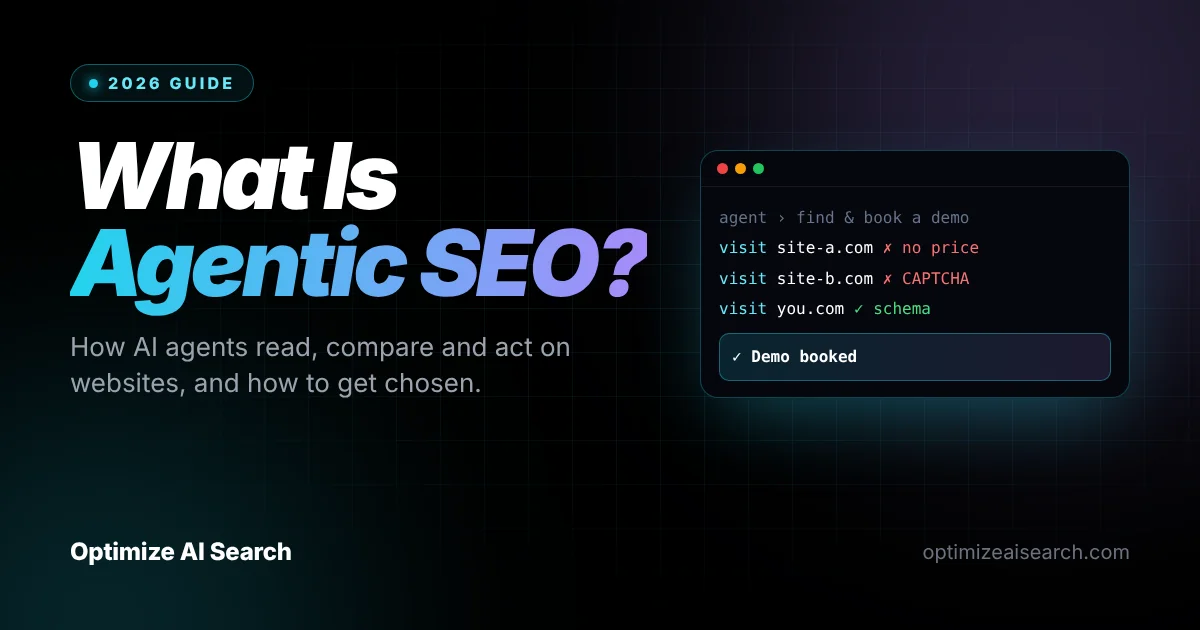
Ask ChatGPT to “find a CRM under $50 a month and book a demo” and something new happens. It doesn’t just list options. It opens websites, reads pricing pages, compares plans and fills in the demo form for you.
That visitor isn’t a person. It’s an AI agent. And it makes decisions very differently from a human scrolling search results.
This guide explains what agentic SEO is, how it differs from SEO and GEO, which agents are already visiting websites, and what you can do this month to be ready for them.
Quick answer: Agentic SEO is the practice of making your website easy for AI agents to find, understand and act on, so that when an agent shops, books or researches for someone, it picks your site and can finish the task there. The term is also used for using AI agents to carry out SEO work.
What is agentic SEO?
Agentic SEO (also called agentic search optimization or agent engine optimization) is about one question: can an AI agent use your website?
Traditional SEO helps a person find your page. GEO helps an AI answer mention your brand. Agentic SEO covers the step after that, when an agent visits your site to check a price, compare a plan, fill a form or buy something on behalf of a real customer.
You will see the phrase used in two ways:
- Optimizing for agents. Making your pages, data and journeys readable and usable by AI agents such as ChatGPT agent, Google-Agent, Perplexity Comet and Claude. This is the main meaning and the focus of this guide.
- Optimizing with agents. Using AI SEO agents, software that runs SEO tasks on its own, to crawl sites, cluster keywords or track AI citations faster than a manual team can.
Both are real. But the first one changes what your website needs to do, so it matters more.
What is an AI agent, and how is it different from a chatbot?
A chatbot answers. An agent acts.
When you ask a chatbot for the best running shoes, it writes a reply from what it already knows or what it found in search. When you ask an agent the same thing, it can open retailer sites, check sizes and stock, compare delivery dates, and stop at the checkout for you to confirm.
To do this, agents load web pages much like a browser does. Many combine what they see on screen with the page’s underlying HTML and its accessibility information, the same labels and structure that screen readers use. That detail matters, and we will come back to it.
Agentic SEO vs SEO vs GEO
These three build on each other. You still need the earlier layers for the later ones to work.
| SEO | GEO / AEO | Agentic SEO | |
|---|---|---|---|
| Goal | Rank in search results | Get cited in AI answers | Get chosen and used by AI agents |
| Who reads your page | A person | An AI model summarising for a person | An AI agent acting for a person |
| What wins | Relevance, links, page experience | Clear facts, sources, entity trust | Readable data, visible prices, forms that work |
| Typical failure | Page 3 rankings | Never mentioned | Agent gives up and books elsewhere |
| Success metric | Clicks | Citations and share of voice | Completed tasks, AI referrals, conversions |
A simple way to remember it: SEO gets you ranked, GEO gets you cited, agentic SEO gets you chosen. If you are new to the middle layer, our GEO service page explains how AI citations work, and Google’s decision to name GEO and AEO in its own docs shows why the shift is now official.
Why agentic SEO matters now
For years, “AI agents that shop for you” was a demo. Over the last year it became real infrastructure:
- September 2025: OpenAI and Stripe launched the Agentic Commerce Protocol, which powers Instant Checkout inside ChatGPT.
- January 2026: Google and Shopify announced the Universal Commerce Protocol, backed at launch by retailers such as Walmart, Target and Etsy and payment firms such as Visa and Mastercard.
- March 2026: Google added Google-Agent to its list of web fetchers, the identity its agents use when they visit sites on someone’s behalf.
Traffic is following. Adobe reported that AI-driven traffic to US retail sites grew about 4,700% year on year by mid-2025, and OpenAI has said around 2% of ChatGPT queries are shopping-related. McKinsey projects that agents could orchestrate up to $1 trillion in US retail revenue by 2030 (source summary).
That said, trust is still catching up. A YouGov survey found 65% of US adults trust AI to compare prices, but only 14% trust it to place the order. So today, most agent visits are research: shortlisting, comparing, checking details. That is exactly where an unreadable site loses out first, long before checkout.
Which AI agents are visiting websites?
Most of these are “user-triggered”: a real person asked for something, and the agent came to your site to get it. They behave differently from search crawlers like Googlebot, which crawl on a schedule.
| Agent | Shows up in logs as | Worth knowing |
|---|---|---|
| ChatGPT agent | ChatGPT-User | OpenAI says it respects robots.txt |
| Google’s agents (e.g. Project Mariner) | Google-Agent | Generally ignores robots.txt because a person started the request; Google is testing signed requests via Web Bot Auth |
| Perplexity / Comet browser | Perplexity-User | Supports shopping with PayPal through Instant Buy |
| Claude | Claude-User | Anthropic says it respects robots.txt |
| Microsoft Copilot | Varies (Edge / Bing) | Can read and act on pages open in Edge |
One practical point: because Google-Agent generally doesn’t follow robots.txt, a robots rule alone won’t control it. If you need to limit it, that happens at your server, CDN or firewall. For a deeper look at how bots find and read pages, see how AI search crawlers discover and understand your website. And if ChatGPT never mentions you at all, start with why your website doesn’t appear in ChatGPT.
How AI agents “see” your website
Agents don’t admire your design. They look for facts and for actions they can take. In practice, that means four things:
- The raw HTML. If your prices, product details or opening hours only appear after JavaScript runs, some agents will never see them.
- Structured data. Product, Offer, Service, LocalBusiness and FAQ schema give agents clean facts they don’t have to guess at.
- The accessibility layer. Labelled form fields, real buttons and clear link text help agents understand what each control does. A form field with no label is as confusing to an agent as it is to a screen reader.
- Whether they are allowed in. Bot rules, CAPTCHAs and aggressive firewalls can stop an agent at the door.
Here is the useful takeaway. A website that is genuinely accessible is already most of the way to being agent-ready. The work you do for screen-reader users pays off twice.
An agentic SEO checklist
Start with your money pages: pricing, product, booking, quote and contact. Then work through these. For the full version with code examples, see our step-by-step guide on how to optimize your website for AI agents.
1. Put key facts in the HTML
Prices, plans, stock, sizes, service areas and hours should be readable without running scripts. Check with “View source”, not just the live page.
2. Add structured data that matches the page
Use Product and Offer schema for products, Service and LocalBusiness for service firms, and FAQPage where it fits. The values must match what users see. Mismatched schema erodes trust. Our breakdown of the seven foundations of SEO with AI shows where schema fits alongside content and authority.
3. Show prices, or at least ranges
“Contact us for pricing” often means “skip this site” to an agent asked to compare options. If you can’t publish exact prices, publish ranges or starting prices. SaaS companies feel this most when buyers ask AI to build a software shortlist.
4. Make forms agent-friendly
Use real <label> tags, clear button text such as “Book a demo”, sensible field types, and as few steps as possible. Avoid fields that only appear on hover.
5. Review your bot and firewall rules
Many sites blocked “all AI bots” in 2024 to stop training crawlers. That same rule can now block a real customer’s agent. Treat training crawlers and user-triggered agents as separate decisions.
6. Remove blanket CAPTCHAs
A CAPTCHA on every page stops agents completely. Keep challenges for genuinely risky actions, such as login or payment, and use bot management that can recognise verified agents.
7. Add machine-readable extras
Keep XML sitemaps clean, consider an llms.txt file, and if you sell online, look at product feeds and the agent channels offered by Shopify and Stripe. Our guide on optimizing product pages so AI recommends them covers the product side in detail.
A 15-minute test you can run today
You don’t need tools to see how agents treat your site. Try this:
- Open ChatGPT’s agent mode (or another browsing agent) and give it a real task, such as “Find the price of [your product] on [yourdomain.com] and request a quote.”
- Watch where it hesitates, scrolls back or gives up. Those are your blockers.
- Ask it afterwards: “What information was hard to find on that site?” Agents are surprisingly candid.
- Check your server logs for ChatGPT-User, Google-Agent, Perplexity-User and Claude-User to see how often agents already visit.
Most businesses that run this test find at least one obvious problem within minutes: a pricing table rendered by script, a pop-up that blocks the page, or a form that rejects the agent’s input. For a quick baseline of how AI engines already see your brand, try our free AI visibility checker.
Common agentic SEO mistakes
- Blocking every AI user agent without checking which ones are customers’ agents.
- Hiding key details in PDFs or images, such as menus, price lists or spec sheets.
- Pop-ups and cookie walls that cover the content agents need to read.
- Schema that says one thing while the page says another, for example an old price.
- Measuring only clicks. Agent visits rarely look like normal sessions in analytics, so they are easy to miss.
What about AI SEO agents?
The second meaning of agentic SEO is about how the work gets done. An AI SEO agent (sometimes called an SEO AI agent) is software that runs tasks on its own: crawling a site for issues, grouping keywords and prompts, drafting briefs or checking AI citations every week.
These tools save real time on repetitive, data-heavy work. But they make confident mistakes, and they don’t understand your brand, your customers or your priorities. The approach that works is agents doing the legwork and an experienced SEO reviewing every change before it ships.
Frequently asked questions
Is agentic SEO replacing traditional SEO?
No. Agents still rely on search indexes and AI answers to decide which sites to visit, which is why ChatGPT SEO and LLM optimization still matter. Strong SEO and GEO get you onto the shortlist. Agentic SEO makes sure the visit ends in a booking, lead or sale.
Should I block AI agents from my website?
Usually not across the board. Blocking training crawlers is a separate business decision. Blocking user-triggered agents can stop real customers from getting answers or completing purchases through their assistant.
How do I measure agent traffic?
Look in server logs for agent user agents, track referrals from chatgpt.com, perplexity.ai and similar sources in GA4, and repeat the 15-minute agent test above every month to see whether tasks get easier to complete.
Is agentic SEO only for ecommerce?
No. Agents also book appointments, request quotes, compare software plans and shortlist service providers. Clinics, law firms, agencies, SaaS companies and local services all have journeys an agent might try to complete.
Where to start
Pick your three most valuable pages. Run the 15-minute agent test on each. Fix what stops the agent first, usually hidden prices, script-only content or a difficult form. Then add structured data and review your bot rules.
If you would rather have this done for you, our agentic SEO services include live testing with ChatGPT agent, Google-Agent and Perplexity, a prioritised fix list, and the technical and content work to make your site the one agents choose. You can also start with a free AI visibility audit.